Saturday, 11 March 2017

Why It Is Structurally Wrong To Build Directly On Plain Ground - Osaz’ ENOBAKHARE

As construction cost rises due to attendant rise in prices of building materials, the trend of building houses directly on plain ground has been observed to be on the increase especially by unscrupulous developers and contractors. Having carried out an independent monitoring of construction activities in some areas in the Ajah axis of Lagos lately, it became obvious that in order to save cost people have resorted to constructing buildings directly on plain grounds.

The awkward idea been adopted in most of the cases under study is to sand-fill the land, level and compact it with the use of machines and the construct a reinforced concrete strip foundation directly over it without recourse to minimum construction/engineering standards.

They do so very quickly so that before any of the regulatory bodies saddled with the responsibility of building control gets wind of their ill act, they are already on super-structure level at which point it is burdensome to ascertain how the foundation was actually built. 

On a particular site, using this vague method the entire foundation including the ground floor slab was put up in one week and by the next week, they were already building up the walls and frame. Dishonest developers thrive in such indecent acts and sell or lease these buildings to unsuspecting prospective buyers who in-turn occupy them or cause others to do so by way of lease/rent too. There is no consideration for lives and properties put at risk of an imminent collapse even as some of the buildings observed are already exhibiting symptoms of instability and sick building syndrome pre-occupancy.

Five years post-occupancy, the building over-settles (or sink) and then tilt in a particular direction. When asked, some of these developers claim that before there will be any major issue with the building they would have recouped the returns on their investment and its left to the new owner to do a repair by way of underpinning as the need arises. To know that some greedy professionals have joined the bandwagon of quacks in delivering such poor structures is condemnable. This act should not be encouraged in any form.

Here are some structural considerations; normally after leveling and compacting operation has been carried out on a sand-filled land it still remains a made-up ground. Although the land becomes stiff at sub-surface levels, this doesn’t in anyway erase the fact that the underlying bad soil (or peat) remains intact and retains its poor attributes. Peats are highly compressible soils and will naturally compress upon the impact of load. As this happen, the building will settle indifferentially, especially during seasonal changes and mass movement of the earth; which occurs at various times of the year.  Such structural anomaly often leads to poor stability of the building and eventually a collapse if unable to bear the load, especially for single or multi-storied structures.


Rising cost of building materials should not be a yardstick to adopt poor construction methods in the construction of buildings and estate infrastructure anywhere. The authorities should not turn a blind eye to such activities that jeopardizes or threatens the lives of people as well as the overall health of the built environment. Project owners and developers should not connive with contractors or builders to manipulate well established engineering prinicples. It is important to select a good contractor for your projects. Yes, there is room for adopting cost-saving methodologies like the use of dry construction methods, cold brick construction, etc but bad construction methods is never the way to go.   

Thursday, 9 February 2017

Dredging to Sand-fill an Estate: The Tricks and Gains -Osaz’ ENOBAKHARE


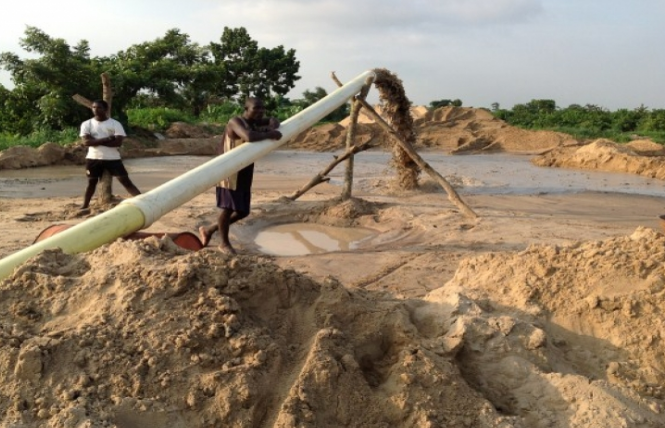
Developing housing or industrial estates close to large water bodies throw open the option of dredging to sand-fill with the aim of reclamation or just to prepare the site for the construction of buildings and infrastructure on it and/or to get sand for the actual construction. In more extensive application, sands can be dredged to stockpile and sell. Basically, for estate development the option of dredging is often weighed alongside the possibility and cost-effectiveness of the alternative approach of trucking sand from nearby sources.

Contrary to popular opinions, industry estimates reveal that for mini-estates (of 5 acres or less) located close to water bodies with shallow fill depth (not exceeding 1-metre) and where manual dredging is prohibited, the option of trucking has proven to be cheaper than mechanical/hydraulic dredging. 

Besides unlike dredging which restricts the user to the particular quality of sand deposits available in that water body at the material time, trucking also allows for the use of a variety of filling materials. However beyond these rare scenarios, mechanical/hydraulic dredging remains the best approach.

Although manual dredging is still the cheapest form of dredging, it is tedious, relatively slow and highly risky hence no longer in vogue. Mechanical/Hydraulic dredging allows for the digging up of mud, sand, gravel, pebbles, rocks and other deposit from the bottom or sidelines of the water bodies by means of a mechanically or hydraulic-driven equipment known as a dredge (or dredger). There are various types of dredgers each defined by its mode of operation. However local industry folks can easily relate with two popular types which are Cutter-Section and Plain/Jet Suction Dredgers.  The striking difference is that the former cuts into the bed, agitates it and sucks up the mixture before transferring it to the end point through a pipeline while the Suction dredger simply sucks up the sand directly and transfer.

Dredging activities requires you to obtain a license/approval which is given by the appropriate authorities after providing relevant documents. These conditions defer from state to state across Nigeria but generally a sand search is often conducted at first to determine the source, availability/quantity and quality of sand in the water body or shoreline to be dredged. This sand search result is often the first and major item developers look out for in a hydrological survey carried out pre-dredging. There is really no need attempting to dredge what is not available in required quantities? A Bathymetric survey is also carried out to determine the depth and bed ‘topography’. Both surveys are often used interchangeably to mean the same thing but they actually have their specifics. An Environmental Impact Assessment (EIA) is then carried out to determine the level of impact the proposed dredging activity will cause to the environment. 

The most suitable type of dredger to be used for a project is largely determined by the cost of purchase or leasing, the size of task to be performed, pumping requirements par efficiency as well as the nature of the sand deposits present. From observation, most small estate owners normally opt for suction dredgers of 8 – 14 inches with sand capacity averaging 350 cubic-metres of sand per hour; relatively cheaper to purchase or lease.  Larger cutter-section dredgers sizing up to 18 inches or more with sand capacity reaching 1000 cubic-metres of sand per hour is in high demand among medium and large estates’ owners. Experience shows that the rate of breakdown of jet suction dredgers on sites is relatively higher than the cutter-section type owing to their inability to withstand stresses associated with sucking up very stiff clay and rocks. But in any case, with a good dredger pumping sand constantly into your site, the heavy cost and risks associated with long-distance sand trucking is completely erased. 

Wednesday, 8 February 2017

Improving Construction Speed by Mass Block Production - Osaz’ ENOBAKHARE

In most completed building projects, the items of work either classified as wall or associated with the use of block/bricks normally constitutes at least 20 percent of the total volume of work done. Now that’s substantial. Block/Brick wall often extends from the substructure through to the superstructure and extensively, the external works. In Nigeria, the most common types of walls built till date are made from hollow sandcrete blocks which come in standard widths of 6 and 9-inches (i.e. 150 and 225mm). Although in some parts of the country, there is appreciable use for solid sandcrete blocks.

There is also a growing market for baked Redbricks, Polyblocks, Lateritic Coldbricks, Nvarsform, Hydraform, Ecobrava, etc. as well as hollow and solid concrete blocks made from crushed stones. But put together, they still accounts for less than 50% of the total existing wall forms in modern construction in the local industry. For medium and large sites, it has been observed that the time taken to produce blocks/bricks readily available for use is often mismanaged thereby contributing largely to project overstay. 

On the one hand, contractors have overtime observed that relying on supply of blocks/bricks from a production factory increases the overall project costs and do not always guarantee desired quality and speed of delivery; therefore it becomes imperative or perhaps reasonable to produce on site.

Visits to several estate project sites across the country recently reveal that the old single-or double-mould block machine is still in common use. When asked why they choose to stick to the old ways of doing things, they often lament that they do not have reliable information on how to get mass block/brick production machines and may equally not know how to use them. Working with a unit of the popular single-mold machine, workers are only able to produce some 300-500 blocks per day (i.e. 8-hour construction time). Then the down-times which are pretty-more frequent than the new variants. These low production capacities measured against time spur contractors of sizeable sites to acquire some more units of the same ‘old-clog’ machine just to beat time. But why have 3 units of the same machines with 3 different operators each and their respective 4-man supports to produce say 1000 blocks a day when with just a single gang you can produce 1000 or more blocks a day using a single unit of mass-production machine? Ironically, its penny foolish, pound foolish.

Furthermore, using variants of multi-mould machine erases the cost associated with the use of block palettes (i.e. the sitting table/plank for freshly-molded blocks) which as at December 2016 goes for an average price of 400 Naira per piece. The new machine class literarily lay blocks directly on the floor as it pulls along. In-tune contractors and block makers are fast trading-off their old machines for the new variants. Interestingly, most of these machines possess higher compression potentials and come with automatic mould changing functions. Some users order for those with trio-capacities; for produces blocks, lateritic bricks and concrete pavers together.  For mega projects, machines with installed capacities of 3000 - 5,000 bricks/blocks per day are highly recommended. It is believed that the market for these new machine variants would increase rapidly in coming months.